
Main navigation
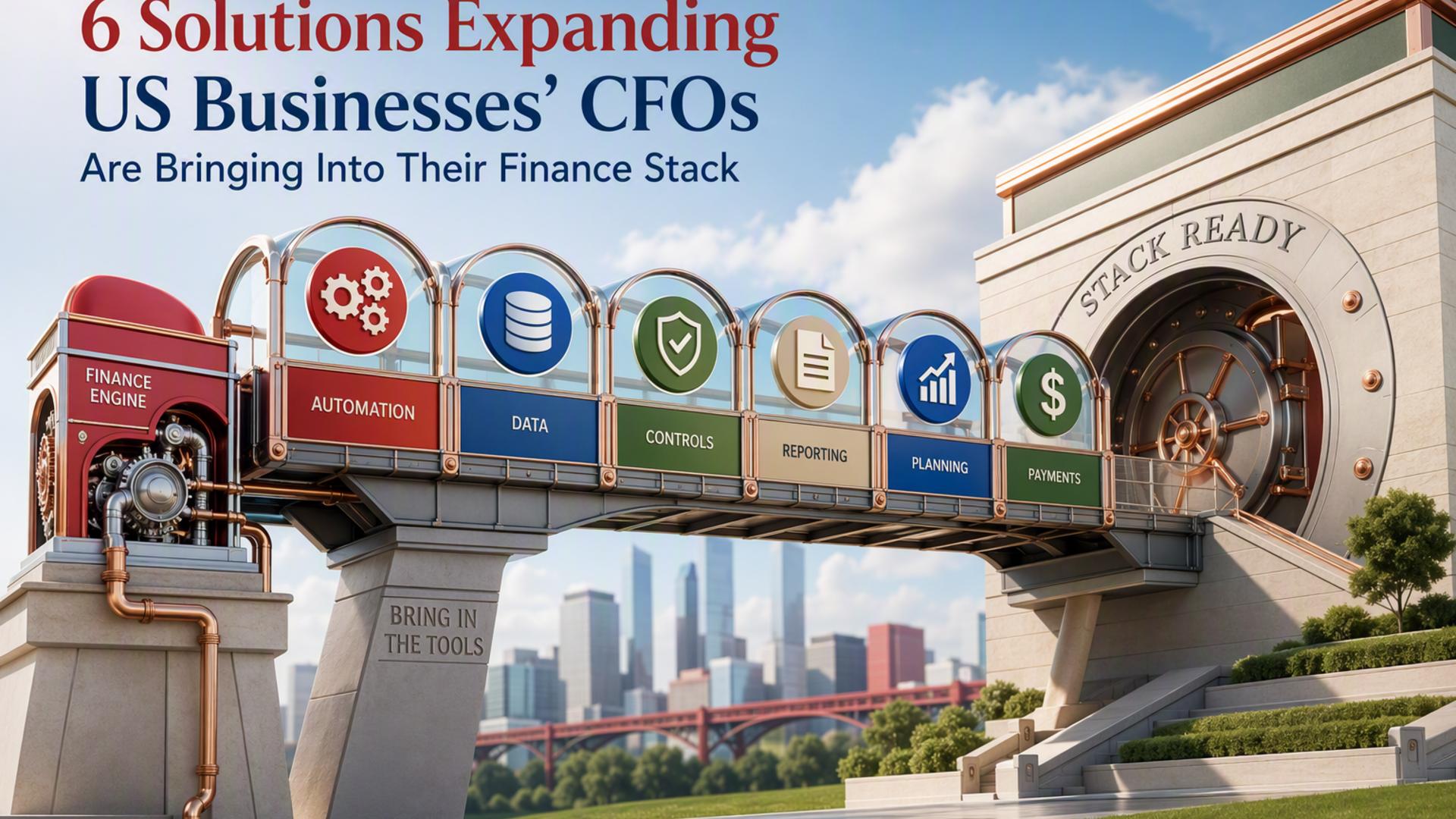
Six Finance Platforms CFOs at Expanding US Companies Are Bringing Into Their Technology Stack
Over the last ten years, the CFO role within a growing US business has evolved substantially. Rather than focusing solely on accurate reports of past financial performance, CFOs are now expected to provide up-to-the-minute visibility, evaluate future financial scenarios, and contribute directly to strategic decisions. Tools that were sufficient at an earlier stage of growth are increasingly unable to support those demands.
CFOs who perform effectively in this broader role are assembling connected technology stacks that automate financial-data creation, reveal insights as they emerge, and free finance teams to focus on analysis and strategic guidance instead of the operational work of closing the books. The following six platforms are increasingly common parts of that stack.
1. Sage Intacct: Financial Management in the Cloud
G2 rates Sage Intacct as the number one accounting software for midsize businesses, and it serves as the financial foundation for the other platforms covered here. Through its real-time general ledger, multi-entity consolidation, dimensional reporting, and automated close functions, the platform provides CFOs with the accurate, current data required for modern financial leadership.
According to customer data, Sage Intacct enables growing US businesses to achieve an average 79% reduction in close time and a 65% productivity improvement. It automates reconciliation, consolidation, and reporting activities that take up the greatest share of finance-team time in less capable systems. Its open API also enables deep integrations with CRM, HR, and business intelligence platforms, allowing it to function as the financial center of a connected stack.
Why it matters: A platform that delivers current financial information while automating complex work provides the base required for every other part of the modern CFO role.
2. Vanta: Security and Compliance Automation Platform
As a US business expands, compliance obligations that once seemed theoretical can become actual barriers to financial and commercial progress. Enterprise customer agreements may require proof of security controls, audits depend on documented compliance frameworks, and lenders and investors ask about data protection standards. Vanta automates both the implementation and ongoing monitoring of security and compliance standards, including SOC 2, ISO 27001, and HIPAA, while maintaining the audit and due-diligence evidence required without a dedicated compliance team or an urgent reactive effort.
The value of Vanta is especially clear to CFOs who have encountered the financial consequences of a compliance finding or lost revenue because the business could not provide a required security certification in time.
Why it matters: Automated, proactive compliance management converts potentially expensive reactive projects into an ongoing state of preparedness that can support growth.
3. Rippling: Workforce Management Platform
People-related expenses are the highest cost for most growing businesses, but many CFOs rely on workforce-cost information that is always at least one pay period out of date. Rippling brings HR, payroll, benefits, and spend management together in one platform and integrates with Sage Intacct. As headcount changes happen, it sends real-time workforce-cost information to the financial system instead of waiting until the following payroll close.
For CFOs balancing headcount plans with financial forecasts, seeing the financial effects of each hire, termination, and compensation adjustment in real time represents a meaningful improvement over the manual, delayed process used by most businesses today.
Why it matters: In organizations where people are the biggest and least flexible cost driver, current workforce-cost data is critical for sound margin management and headcount planning.
4. Salesforce: CRM and Revenue Intelligence Platform
For growing US businesses that have a sales function, linking CRM pipeline information to the financial system is among the most valuable integrations a CFO can establish. When Salesforce is connected with Sage Intacct, pipeline deals automatically create immediate financial implications within the revenue forecast. Recognized revenue, deferred revenue, and committed pipeline can then be viewed in one connected picture instead of across separate systems that require manual reconciliation.
Forecasts based on live CRM information are materially more accurate than those built from historical averages. That visibility enables finance teams to plan cash flow, resourcing, and investment with significantly greater confidence.
Why it matters: Bringing sales and financial information together improves forecast accuracy and narrows the gap between commercial teams’ view of the company’s direction and finance’s understanding.
5. Mosaic: Platform for Strategic Finance
Designed specifically for growing US businesses, Mosaic is a strategic finance platform that connects with Sage Intacct and other data sources. It delivers real-time revenue intelligence, headcount planning, and financial modeling through a single interface. CFOs currently rebuilding spreadsheet-based models each month can instead use a persistent, connected model that automatically updates when actual results are received.
The platform is intended to help finance teams move beyond reporting past outcomes and toward advising the business on its next actions the shift growing businesses require from their CFOs.
Why it matters: By connecting strategic-finance capabilities, the platform helps turn finance from a historical reporting function into a forward-looking strategic business partner.
6. Workato: Platform for Integration and Automation
Growing businesses add systems over time, including CRM, HR, e-commerce, and project-management tools. In the absence of an integration layer, finance teams become the manual connection among those systems, using valuable time to export and reenter data that should move automatically. Workato creates and manages automated workflows across business systems without custom development, helping ensure that financial information remains current and consistent throughout the operation.
For CFOs whose teams devote substantial effort to transferring data and reconciling disconnected systems, Workato typically creates an immediate and significant reduction in that work.
Why it matters: Automation across integrated systems eliminates manual data-management activity that uses finance-team capacity without creating analytical value.
Frequently Asked Questions
How does a modern CFO role differ from a traditional finance director position?
Historically, finance directors focused mainly on accurate reporting of past activity: properly closing the books, preparing financial statements, and maintaining compliance. A modern CFO also needs real-time financial visibility, scenario-based forecasts, active involvement in strategic decisions, and cross-functional business partnerships. These expanded responsibilities call for a fundamentally different technology stack one that continuously generates current data rather than producing accurate information only at intervals.
How can a CFO make the case for investing in an upgraded finance technology stack?
The most compelling cases presented to boards measure the cost of the existing approach: finance-team hours devoted to manual work, decision quality when accurate real-time data is unavailable, exposure created by compliance gaps, and the limits current infrastructure imposes on growth. When these costs are expressed financially and compared with the needed investment, the result typically shows a return on investment achievable within twelve to eighteen months for most growing businesses.
Does Sage Intacct replace every other finance tool, or is it intended to operate with them?
Rather than trying to replace every tool, Sage Intacct is specifically built to integrate with best-in-class platforms in adjacent categories. Its open API enables deep connections with leading CRM, HR, and business intelligence tools. As a result, upgrading the financial platform can increase the value of existing systems by linking them to a more capable financial hub, without requiring every system to be replaced at once.
When can a growing business anticipate results after a new financial platform is implemented?
The first highly visible improvement for most businesses is month-end close time, which generally declines significantly during the first two or three cycles following implementation. Real-time dashboard visibility is available from the first day the platform goes live. Longer-term improvements such as stronger forecast accuracy, more effective strategic decisions, and lower finance-team overhead relative to business size develop across the first six to twelve months as the team gains confidence in the new capabilities.
What is the most significant error growing businesses make when modernizing their finance function?
The most frequent and expensive mistake is waiting too long. Once a business recognizes that its financial systems are insufficient, the costs of that insufficiency finance-team time, weaker decisions, and missed opportunities have usually been building for months or years. Another common mistake is investing too little in implementation, whether through selecting an inexperienced implementation partner or failing to dedicate enough internal resources to the project. That can leave a capable platform incorrectly configured and performing far below its potential.

Recent Comments